

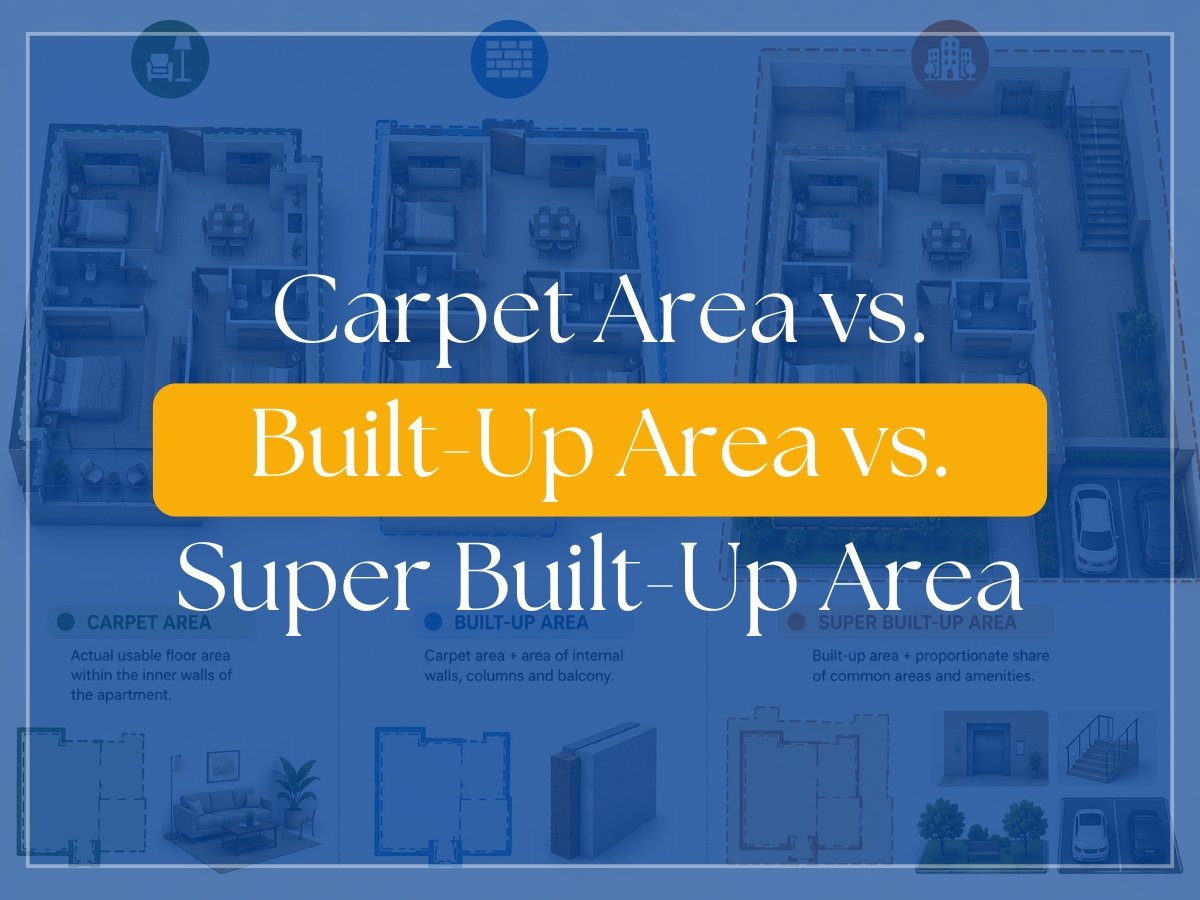
Buying a home is one of the most significant financial decisions you’ll make. Yet, many homebuyers find themselves confused by terms like Carpet Area, Built-Up Area, and Super Built-Up Area.
Understanding these terms is essential because they directly affect the amount of space you get and the price you pay for a property.
If you’ve ever wondered what these measurements mean and why they matter, this guide will help you make sense of them.
Why Understanding Property Area Matters
When browsing residential projects, you may notice that two apartments with the same advertised size can feel very different when you visit them.
The reason often lies in how the area is calculated.
Knowing the difference between carpet area, built-up area, and super built-up area allows you to:
- Compare properties more accurately
- Understand the actual usable space
- Evaluate value for money
- Make informed homebuying decisions
Let’s break down each term.
1. What Is Carpet Area?
Carpet Area refers to the actual usable floor area inside your home.
In simple terms, it is the space where you can physically place furniture, walk around, and carry out your daily activities.
Carpet area typically includes:
- Living room
- Bedrooms
- Kitchen
- Bathrooms
- Internal passageways
It does not include:
- External walls
- Balconies
- Verandas
- Open terraces
- Common areas
Think of carpet area as the space that belongs exclusively to you and can be used for living purposes.
For most homebuyers, this is the most important measurement because it reflects the actual usable area of the apartment.
2. What Is Built-Up Area?
Built-Up Area includes the carpet area plus the area occupied by the walls of the apartment.
Depending on the project, it may also include balconies and utility spaces.
Since walls take up space, the built-up area is always larger than the carpet area.
For example, if an apartment has a carpet area of 700 square feet, its built-up area may be around 800 to 850 square feet, depending on the wall thickness and layout.
Built-up area gives a broader picture of the apartment’s size but still does not include shared spaces within the building.
3. What Is Super Built-Up Area?
Super Built-Up Area is the area most commonly used by developers for pricing residential properties.
It includes:
- Built-up area of the apartment
- A proportionate share of common areas
Common areas may include:
- Lobbies
- Corridors
- Staircases
- Lift areas
- Clubhouses
- Amenity spaces
- Common recreational facilities
Because it includes a share of these common spaces, the super built-up area is larger than both the carpet area and built-up area.
It is often referred to as the “saleable area.”
Understanding the Difference with an Example
Consider an apartment with the following measurements:
- Carpet Area: 700 sq. ft.
- Built-Up Area: 820 sq. ft.
- Super Built-Up Area: 1,000 sq. ft.
In this case, while the apartment is marketed as a 1,000 sq. ft. unit, the actual usable living space available to the homeowner is 700 sq. ft.
This is why understanding the area calculation is so important before making a purchase.
Why Carpet Area Should Be Your Primary Focus
Many buyers focus only on the advertised apartment size, but carpet area provides a much clearer picture of what they’re actually getting.
Two apartments may have the same super built-up area but offer significantly different carpet areas.
A larger carpet area means:
- More usable living space
- Better room layouts
- Improved comfort
- Greater functionality
When comparing properties, carpet area often provides the most meaningful comparison.
What Is Loading?
Loading refers to the difference between the carpet area and the super built-up area.
A higher loading percentage means a larger portion of the area is allocated to common facilities and shared spaces.
While modern amenities can enhance lifestyle and convenience, buyers should understand how much of the total area is actually usable within their apartment.
Evaluating the loading percentage can help determine whether a property offers good value.
How RERA Has Improved Transparency
The introduction of the Real Estate (Regulation and Development) Act (RERA) has brought greater clarity to property transactions.
Under RERA, developers are required to disclose the carpet area of apartments, making it easier for buyers to compare projects fairly.
This has reduced confusion and increased transparency across the real estate sector.
As a buyer, always refer to the RERA carpet area while evaluating a property.
Questions Every Homebuyer Should Ask
Before booking a property, consider asking:
- What is the RERA-approved carpet area?
- What is included in the built-up area?
- What is the super built-up area?
- What is the loading percentage?
- Which amenities are included in the common area calculation?
These questions can help you understand exactly what you’re paying for.
Final Thoughts
Understanding the difference between carpet area, built-up area, and super built-up area is essential for making informed real estate decisions.
While super built-up area is commonly used for pricing, carpet area represents the actual space you will use every day. Built-up area falls somewhere in between, accounting for the apartment’s walls and certain additional spaces.
When evaluating a property, don’t focus solely on the advertised square footage. Instead, pay close attention to the carpet area and overall layout to ensure the home meets your expectations and lifestyle needs.
After all, buying a home isn’t just about the size that’s advertised—it’s about the space you’ll actually live in and enjoy for years to come.







Leave A Comment